



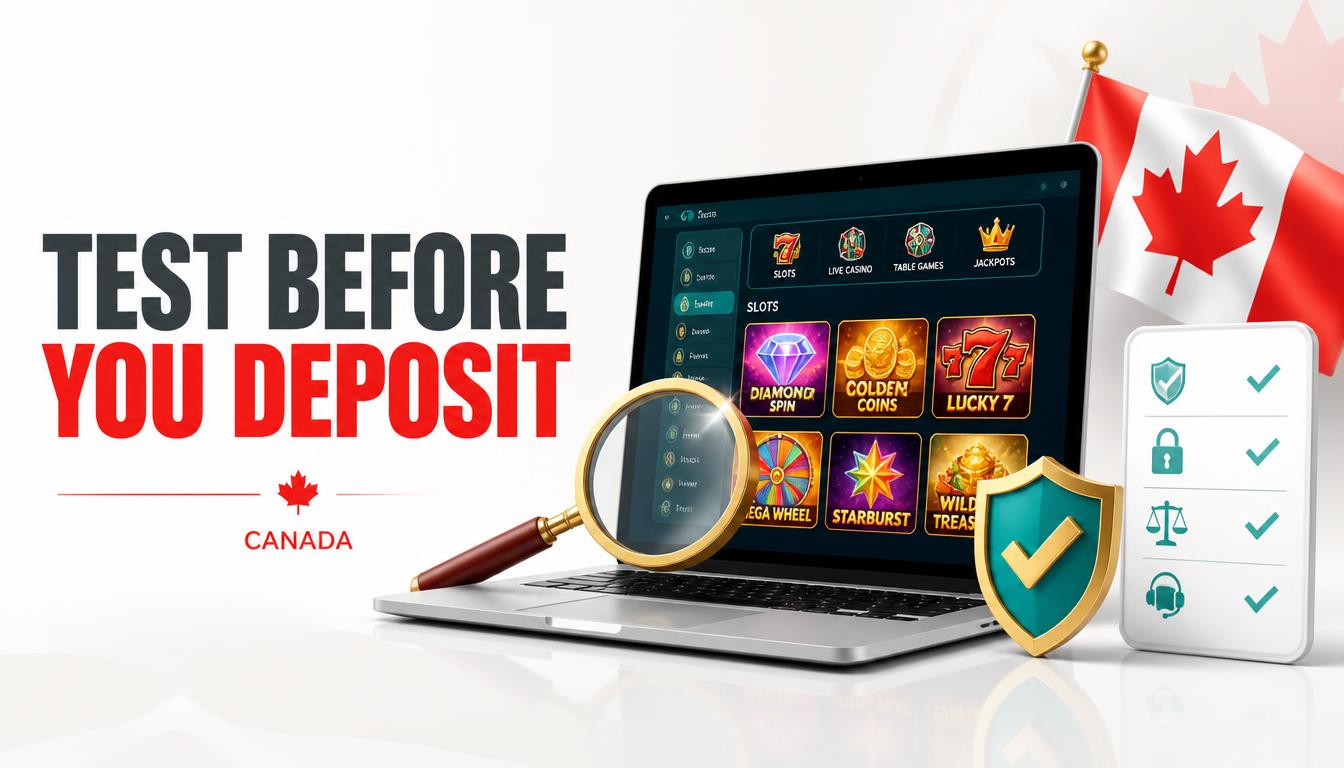
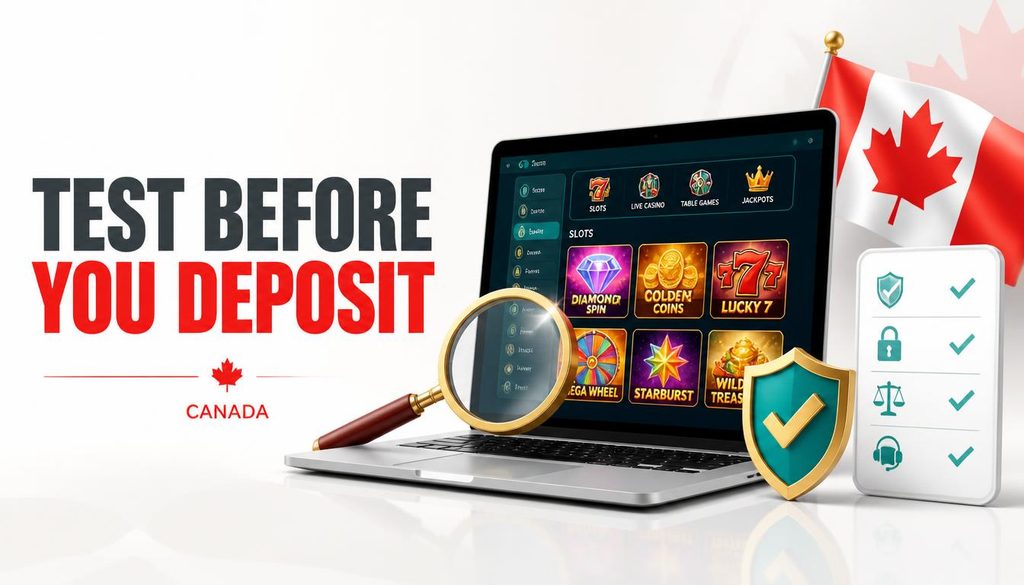
Knowing how to test a new online casino before you deposit can save you a lot of frustration. A new site shows up with a big welcome bonus and a slick homepage, and it looks great. But looks are cheap. The real question is whether you’ll get your money back when you win.
The good news is that you can learn a lot about a casino before you put any money in. Here’s the routine we’d follow ourselves, step by step.
1. Start with the license
This is the first thing to check, and it takes two minutes.
Scroll to the footer of the site and look for a licensing line. A real license comes with a name and a number, and it should link to the regulator’s own website. If you can’t find one, or the logo is just a picture that doesn’t click through, that’s a bad sign.
What counts as a good license for Canadians?
- Ontario: Look for a license from iGaming Ontario and AGCO. If a casino is open to Ontario players, it should be on the official list of registered operators.
- Rest of Canada: Many provinces run their own sites, like PlayNow in British Columbia or Espacejeux in Quebec. Private casinos that accept players from these provinces usually hold licences from places like the Kahnawake Gaming Commission or Malta. These offer some protection, but not as much as an Ontario license does.
Take the extra minute to open the regulator’s site and search for the casino by name. Fake license badges are more common than you’d think.
2. Read the bonus terms (yes, really)
Nobody enjoys reading terms and conditions. But this is where most of the unpleasant surprises hide, so skim at least these points:
- Wagering requirement. This is how many times you have to play through the bonus before you can withdraw. 35x is common, and anything much higher should make you think twice.
- Max bet while wagering. Many casinos cancel your bonus if you bet above a set amount per spin. It’s easy to break by accident.
- Game contributions. Slots usually count 100%, while table games often count far less, or nothing.
- Max cashout. Some bonuses cap how much you can win from them.
- Expiry. Bonuses often disappear after 7 or 14 days.
If the terms are hard to find, confusing, or full of vague phrases like “at our sole discretion,” treat that as a warning.full of vague phrases like “at our sole discretion,” treat that as a warning.
3. Test the customer support before you need it
Support is easy to ignore until something goes wrong, and then it’s the only thing that matters. So test it first.
Open the live chat and ask a couple of simple but specific questions, such as:
- “What’s your withdrawal limit per week?”
- “Do I need to verify my ID before my first withdrawal?”
- “Does Interac e-Transfer have any fees?”
Pay attention to three things: how quickly they answer, whether you get a real answer or a copy-and-paste line, and whether you’re talking to a person who understands the question. If support is slow or evasive when they’re trying to win you as a customer, imagine how it’ll be when you have a problem.
4. Look at the payment options
Check the cashier page, which you can often see without depositing. For Canadian players, you want:
- Interac e-Transfer or Interac Online. It’s the most trusted method here, and its presence usually means the casino takes Canadian players seriously.
- Canadian dollars. If the casino only deals in USD or euros, you could lose money on every deposit and withdrawal through currency conversion.
- Clear withdrawal times. E-wallets are usually fastest, often within a day or so after approval. Bank transfers can take several business days. If no times are listed anywhere, ask support.
- Fees. Check both deposits and withdrawals.
5. Play the free versions first
Most casinos let you try slots in demo mode without signing up. Use it.
You’re not trying to win anything here. You’re checking that the games load properly, the site doesn’t crash, and the layout works on your phone. Also look at who makes the games. Titles from known studios like Pragmatic Play, NetEnt, Evolution or Play’n GO are a good sign. Unknown providers aren’t automatically bad, but the casino should be able to tell you who they are.
6. Register and verify your account before you deposit
Here’s a tip most people skip. You can often create your account and upload your ID before making a deposit.
Casinos are required to verify who you are before paying out, usually with a photo ID and proof of address. Doing this early means you won’t be stuck waiting days to withdraw your first win. It also shows you how the casino handles this process: do they reply quickly and politely, or do they ask for the same documents three times?
7. Start small, then withdraw on purpose
When you’re ready to deposit, keep it small. $20 to $30 is plenty for a test. Skip the huge welcome bonus for now, or at least be sure you understand its terms.
Then do the most important test of all: make a withdrawal.
Play for a bit, and if you end up with even a small amount over your deposit, request a payout. If you’ve lost everything, you can still deposit another small amount and cash out part of it. What you’re checking is:
- How long it takes from request to money in your account
- Whether they ask for strange extra documents
- Whether the amount arrives in full
A casino that pays out a small withdrawal smoothly is far more likely to handle a large one properly.
8. Check what other players say, with a pinch of salt
Search the casino’s name along with words like “withdrawal” or “complaint.” Look at independent forums and review sites, not just the testimonials on the casino’s own page.
Don’t panic over a few angry reviews, since every casino has some unhappy players. What you’re looking for are patterns: many people reporting the same problem, especially slow or refused payouts, and whether the casino responds to them or ignores them.
9. Look at the basic security
A few quick checks:
- The web address starts with https and shows the padlock icon.
- There’s a clear privacy policy explaining what happens to your data.
- You can enable two-factor authentication on your account.
- The site lists who owns and operates the casino, with a company name and address.
10. Set your limits before you play
Before your first real deposit, look for the responsible gambling tools in your account. A good casino makes these easy to find and use:
- Deposit limits (daily, weekly or monthly)
- Loss limits
- Session time reminders
- Self-exclusion and cooling-off periods
If a casino buries these tools or doesn’t offer them, that tells you something about how it treats its players.
Red flags that mean “walk away”
- No license information, or a license you can’t verify
- Bonus terms that are hidden or keep changing
- Support that dodges direct questions
- Withdrawals that are “pending” for far longer than promised
- Pressure to deposit more to “unlock” your winnings
- Requests for documents that make no sense, like your online banking login
Your quick checklist
- Verify the license on the regulator’s own site
- Read the bonus terms
- Test live chat with real questions
- Check for Interac, CAD and clear withdrawal times
- Try the demo games
- Verify your account early
- Deposit a small amount and make a test withdrawal
- Look for patterns in independent reviews
- Confirm basic security
- Set your limits
Before you hit “deposit”
Learning how to test a new online casino comes down to one simple idea: make the casino earn your trust before it gets your money. A site that passes the licence check, answers your questions in live chat and pays out a small test withdrawal without a fuss has earned a fair shot. One that doesn’t has just saved you a headache.
Even with a great casino, your own rules are the best protection. Decide how much you’re happy to spend before you log in, and treat that money as the cost of an evening’s entertainment, not an investment. Don’t chase losses, and don’t let a bonus push you into playing more than you planned. If it stops being fun, step away, use the casino’s self-exclusion tools, or reach out to your province’s free gambling support service.
And of course, play only if you’re of legal age where you live: 19 in most of Canada, and 18 in Alberta, Manitoba and Quebec.