


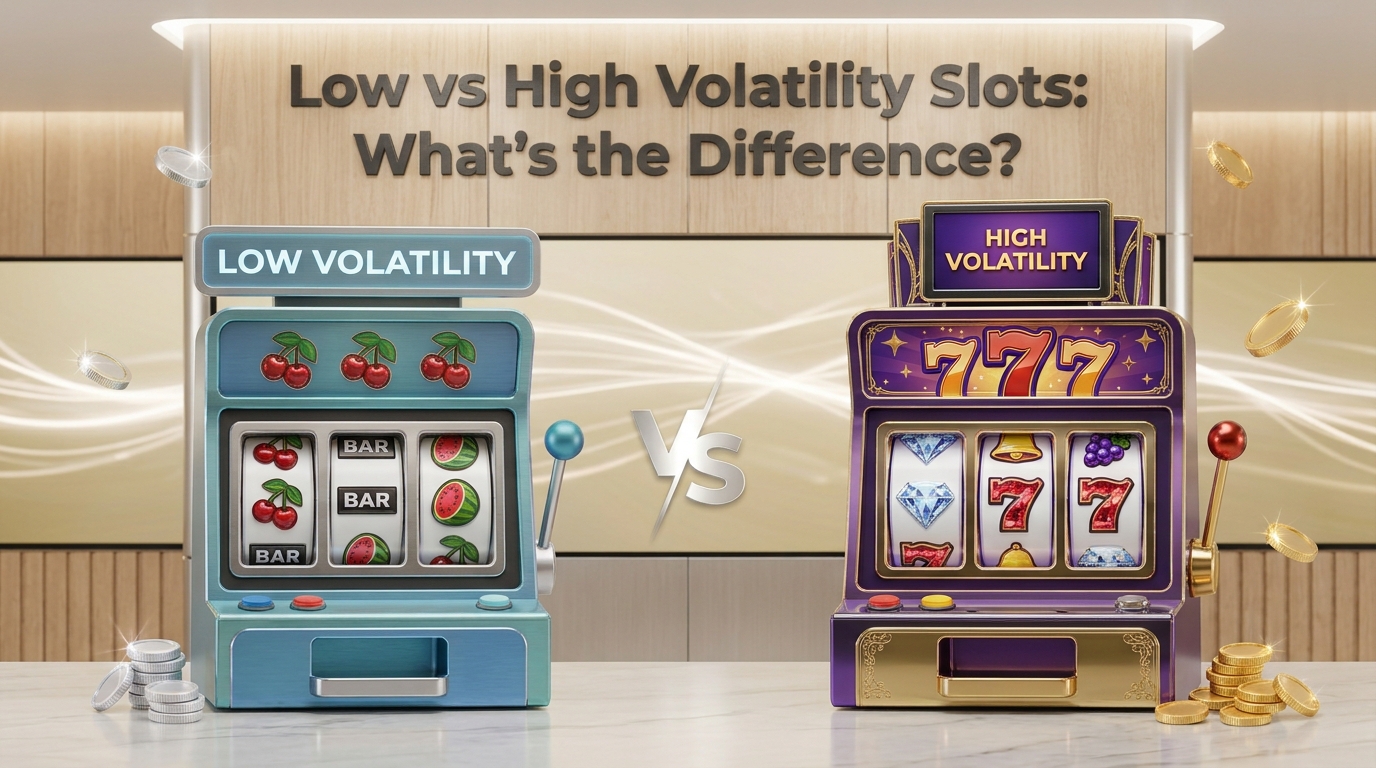
You’ve probably noticed that two slots can feel completely different, even when they look similar. One gives you small wins all the time. Another leaves you with nothing for twenty spins, then suddenly pays out. That feeling has a name: volatility.
Once you understand it, picking a slot becomes much easier.
What is volatility?
Volatility (also called variance) describes how a slot pays, not how much it pays overall.
Think of it as the rhythm of the game:
- Low volatility: frequent, smaller wins.
- High volatility: rare, but potentially bigger wins.
- Medium volatility: something in between.
The same amount of money can be returned in very different ways. Volatility is just the shape of the ride.
Low volatility slots
Low volatility slots hit often, but the wins are usually modest.
A simple example: you play with $20 at $0.40 a spin. You might get small wins every few spins: $0.60 here, $1 there. Your balance drifts up and down gently, and your $20 can last a good while.
Good for:
- Longer sessions on a small budget.
- Beginners who want to learn how a game works.
- Players who like steady action.
The catch: big jackpots are less common, so don’t expect huge swings in your favour.
High volatility slots
High volatility slots can be quiet for a long time, then give a big win in one go.
A simple example: same $20 at $0.40 a spin. You may see many spins with no win at all. Then a bonus round hits and pays $50 or more. Or you may run out of money before it ever happens.
Good for:
- Players who enjoy the thrill of a big hit.
- Anyone with a bigger budget who can handle long dry spells.
The catch: your balance can drop fast. A short session can end with nothing.
How is this different from RTP?
They’re often mixed up, but they measure different things.
- RTP (return to player) is the percentage of all money bet that a slot pays back over a very long time. A 96% RTP means $96 back for every $100 wagered, on average, across millions of spins.
- Volatility is how those returns arrive: in many small pieces or a few big ones.
Two slots can both have 96% RTP, and one can feel gentle while the other feels wild. Neither is “better.” They just suit different players. (For a deeper look, see our guide: What Does RTP Mean in Online Casinos?.
How to find a slot’s volatility
Most reputable providers list it, usually in the game’s info or payable screen. You’ll often see it shown as a label such as low, medium or high, or as a lightning-bolt rating. If it isn’t shown, you can read reviews or try the demo version for free.
Which one should you choose?
Ask yourself two questions:
- How long do I want to play? For long sessions with a small budget, low or medium volatility is usually the better fit.
- How do I feel about losing streaks? If a dry spell would frustrate you, avoid high volatility.
If you’re unsure, start with medium volatility and see how it feels.
Not sure how the reels, paylines and bonus features fit together? Our beginner’s guide, How Do Online Slots Work?, covers it step by step.
A few honest reminders
- Volatility doesn’t predict the next spin. Every spin is random and independent.
- No volatility level is a strategy for winning. It only changes how results are spread out over time.
- Set a budget before you play and stick to it. (We’ve covered how in [link to your budget or deposit guide].)
Final thoughts
Low volatility feels smooth, high volatility feels dramatic, and medium sits in the middle. Knowing the difference won’t change the odds, but it helps you pick games that match your budget and your mood, and that makes the whole experience more fun.
Online casinos are for adults only (18+ or 21+, depending on where you live). Gambling should be entertainment, never a way to make money. If it stops being fun, take a break and consider contacting a support organization such as GamCare or the National Council on Problem Gambling. Check local laws before playing.